Khazri
Historical Context
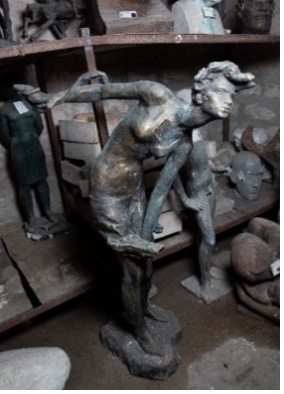
The Khazri wind is one of the defining natural phenomena of the Absheron Peninsula and has played an important role in shaping the region’s landscape, architecture, and everyday life. Over centuries, it has become a symbol of resilience, endurance, and the close relationship between people and nature. In this sculpture, Mirkasimov transforms this familiar natural force into a universal artistic image that reflects humanity’s dialogue with the elements and celebrates the enduring spirit of those who live in harmony with nature.
Cultural/Artistic Inspiration
The figure is depicted leaning sharply forward. The dramatic inclination of the body, the extended neck, the tense shoulders, and the overall sculptural treatment convincingly convey the physical impact of a powerful wind. The figure appears to struggle against the invisible force pressing upon it, creating a sense of dramatic tension and movement. This dynamic plastic solution symbolizes both humanity’s resilience in the face of nature’s power and its inseparable connection with it. The generalized anatomical forms and the rhythmic modeling of the body demonstrate the artist’s ability to combine realism with expressive sculptural language. The balance between the composition’s vertical structure and the forward movement of the figure creates a harmonious artistic unity. Rather than emphasizing external details, the sculptor focuses on the rhythm of movement, inner energy, and the invisible force of the wind, making it perceptible through sculptural form. The work is a poetic reflection on the power of nature, the strength of the human spirit, and the dynamic rhythm of life.
Author
Miralasgar Mirasadulla oghlu Mirkasimov was born on 9 February 1924 in Baku, Azerbaijan. In 1944, he graduated from the Azim Azimzade Art School, and in 1950 completed his studies at the Ilya Repin Institute of Painting, Sculpture and Architecture in Leningrad (now Saint Petersburg). In the years following World War II, Mirkasimov created a number of sculptures dedicated to the defenders of the homeland. From the late 1960s, he devoted much of his career to the creation of monumental public monuments. He participated in numerous All-Union exhibitions, as well as exhibitions held in Warsaw, Bulgaria, Germany, Canada, and other countries. For his outstanding contribution to Azerbaijani art, he was awarded the honorary titles of Honoured Art Worker and People’s Artist of Azerbaijan. Miralasgar Mirkasimov passed away in 2003.